Changing Your Clothes

Shopping, Sewing, Upcycling, Repairing: Make the most of your clothes!


Leave a comment

Santa Fe Wardrobe: P.S.

As a follow-up to my Santa Fe wardrobe follow-up, I thought you might be interested in a few stats about my Santa Fe travel wardrobe:

1. Out of the 9 main items I packed (not counting swimsuit, sleepwear, etc.), I made 6 of them myself:

a. The deep olive green silk twill Origami skirt;

b. The pale sage green wide-legged linen trousers with deep taupe herringbone racing stripes;

c. The print silk crepe de chine one-shouldered tunic;

d. The cap-sleeved sage-and-lavender-print knit top;

e. The print jersey V-neck dress;

f. The hand-knitted one-sleeved entrelac wrap (also my original design)

(The ones I did not make are the jeans, teal knit top, and asymmetrical print top.)

2. The only things I bought specifically for this wardrobe were the following (everything else I already had, including sewing patterns):

a. Fabrics for the linen trousers and cap-sleeved knit top;

b. The jeans

(I also bought the pewter jersey to line the bronze dress, which ultimately did not make it into my suitcase for this trip. All other fabrics came from my stash.) Continue reading


7 Comments

Santa Fe Wardrobe: A Post-Trip Review

Now that I’m back from Santa Fe, I realize that I need to follow up on my previous posts about creating my travel wardrobe for this trip. (See the following if you want to catch up: Santa Fe Travel Wardrobe: Color Palette, and The Fabrics & Projects. I also posted ideas for shopping for this wardrobe: Shopping! and Shopping 2: $49.95 or Less! Meanwhile, I’ll get all these photos ready to show you.)

Honestly, I’m a bit surprised that my actual travel wardrobe turned out almost exactly as I planned it; I’ll give more details about the changes as we go. First, here are photos of the pieces I packed: tops, bottoms, dress.

The Tops The tops; it’s unusual for me to wear prints at all, so you can see I’m trying to push myself! (I made the one-shouldered silk tunic and the sage and lavender cap-sleeve knit top.) Continue reading


Leave a comment

Closet Makeover Ideas, courtesy of Real Simple

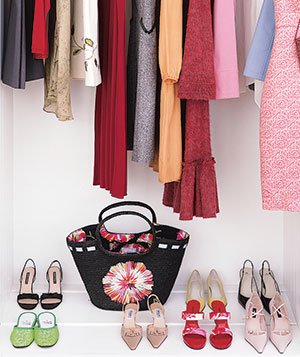
Look what came into my e-mail box this morning: Loads of closet-transforming ideas from Real Simple! From using the proper hangers to space-saving tricks for tiny closets, here are 31 fantastic strategies for your best closet ever!

What are your favorite tips for keeping your closet under control?

Add a Shoe Platform

Closet tip: Add a shoe platform! (Click on this picture to go directly to this tip at Real Simple.)


Leave a comment

Spooling Colors: A Spontaneous Palette

I was working on a sewing project the other day, and was changing thread colors on my sewing machine. Without really looking at what I was doing, I set down the sage-green spools I’d been using (laying them behind the machine so they wouldn’t roll off the slightly sloping table). Something back there caught my eye, and I suddenly noticed that I had put the green spools down on top of a zip-top bag with a couple of spools inside it. This is exactly what I saw:

Thread palette

I just love the way these colors look together, but how do you translate that into an actual palette? Go to ColourLovers! (The link will take you to my page on ColourLovers, but feel free to browse the whole site. It’s worth the trip, I promise.) Using this photo as my starting point, I created this palette:

Threads palette on ColourLovers
Threads palette created on ColourLovers; note the addition of the white (from the spools) and charcoal grey (from the background of the photo).

When you’re looking at a photo like the one with the threads, the subject matter of the photo can be distracting; it’s often easier to visualize using a color palette when you can see it in solid, flat colors as in the ColourLovers palette.

Why don’t you try creating your own custom palette with a photo? Even photos that are not that great (out of focus, etc.) can be rich sources of beautiful color palettes. You can do this online at ColourLovers, and/or use their palette-creation software, ColorSchemer Studio (they even have a smartphone app version of this!). Have fun! And be sure to post your palettes here for us all to enjoy!


1 Comment

Food Coloring: Just Beet It!

All right, maybe I’m taking this color obsession a little too far… Yesterday, when I was visiting my sister up in Poulsbo, Washington, we were enjoying a wonderful home-cooked lunch at her house that included many young, delicious vegetables from her garden (and a chicken). This locovore’s delight included a dish of beautiful beets, regular (or whatever the red ones are called) and golden, together on a platter, thus:

Beets Beets, part of a delicious lunch at my sister’s house. Little did she know… Continue reading


Leave a comment

Stay! Taming a Beastly Narrow Hem

I was working on sewing a printed silk charmeuse top a couple days ago, the one-shouldered tunic from my Santa Fe wardrobe. This top, I might say, was by far the most straightforward garment I’ve made in quite a while; I have a tendency to complicate things by, say, adding a sheer or lace layer, tuxedo stripes to pant legs, or maybe just choosing a fabric that makes matching stripes or patterns necessary. But since I’m working with a gorgeous print (rare for me), I decided to let the fabric do the talking.

The only issue I had was the hemming of the one sleeve. It’s a slightly belled shape that forms a curving hemline; it’s also the only place on the entire garment where stitching shows on the outside  (I’m doing the lower hem by hand). And the soft, slinky, yes, silky nature of the fabric makes it among the more difficult to manipulate into a narrow hem, especially one stitched by machine.

Narrow hems: Usually, when a pattern says to finish a piece with a narrow hem, they mean a hem that’s folded under twice (hiding raw edges), then stitched. And since it’s called a narrow hem, it usually means 1/4″ wide, possibly slightly more.

I thought maybe I could do a modified version of the multi-step machine-stitched hem that I’ve used on chiffon; this technique involves stitching, trimming, stitching again, folding, pressing, stitching a third time. For my sleeve, the plan was to make good use of stay-stitching, mainly to stabilize the hem edge. (Remember the ripply original hem on my white linen skirt? This is how to avoid that.)

Stay-stitching: This is simply a line of stitching, usually worked inside the seam allowance, that’s not meant to be seen; its function is to stabilize, and sometimes to reinforce certain areas, such as the V of a v-neck, or a curving edge that needs to be clipped to lie flat.

Step 1: Stay-stitch 1/4″ from cut edge, fold to wrong side and press,  just inside stitching line.

Tip: be careful to use a stitch length that’s a little on the long side (I used a stitch length of 3); this will help prevent puckering.

Narrow hem, stitched, folded, & pressed Narrow hem, stitched 1/4″ from cut edge, folded to wrong side just inside stitching line, & pressed (in that order). Continue reading


5 Comments

Hem My Skirt, Part 2: Happily Hemmed In!

It’s interesting how projects evolve. In Hem My Skirt, Part 1,  my main objective was to cut off the stained lower edge of my white linen skirt, to at least make it wearable (albeit 6.5″ shorter). The challenge was to mark and cut the skirt to its new length— said skirt being bias-cut, with a curving, A-line-verging-on-semi-circular hem. End of Part 1 found us with a newly-trimmed skirt, hanging for a couple of days before hemming (a necessity when working with bias-cut garments).

However, once I started working on preparing the trimmed-and-hung skirt for the sewing of the new hem, I realized that, along with getting rid of the stained part of the old hem, I could also improve on the finishing of the machine-stitched hem. Here’s how it looked originally, folded under twice, then sewn:

Skirt with original hem Skirt with original hem, turned under twice before machine-stitching; note the ripply edge, not a good finish for a bias-cut skirt, in my opinion. We can improve on this. Continue reading


1 Comment

Hem My Skirt, Part 1: A Short (& Biased) Story

I have a white skirt dilemma, and it’s almost Labor Day— I think it now qualifies as an emergency! If I don’t fix this skirt now, I’ll have to bow to the Goddess of Fashion Rules and pack it up until next Memorial Day.

Here’s what’s going on. Last week, when temperatures here in Portland were hovering around 100, I finally fished my one and only white linen skirt out of the ironing pile. (My working theory was that just wearing white linen would give me the psychological advantage over the weather forecast. The jury’s still out.) Well, when I was about to start ironing the skirt, I started to notice a series of strange stains, all more or less near the hemline; strange because they all felt sort of hard, as if wax or something like that had fallen on the skirt and stiffened up. (Don’t ask me how this happened. I’m still scratching my head. I’m thinking these are some of those phantom things that happen in the laundry, much to my mystification.) It’s a little hard to see the stain in this photo,  since it’s more hard than dark, but you can just make it out:

Stain on White Skirt

One of several mysterious stains on my white linen skirt. No amount of soaking or treating seemed to make any difference.

I found stains like this one in several places, but they were all within 5 inches or so of the hem. Now, this skirt is bias-cut, A-line, and (originally) 30″ long from waistband to hem, which translates to mid-calf length on me (I’m over 5’8″ tall). So I thought it might be possible to simply re-hem the skirt to a shorter length, cutting off the offending stain-ridden area. Aha, I thought, I can get rid of the stains and make my skirt a more modern (and flattering) length simultaneously! Brilliant!

Of course, these brilliant ideas often don’t take certain issues into account. As I said, the skirt is bias-cut; this doesn’t necessarily make it more difficult to cut, but the stitching of the new hem will be a little more involved. So for today, I’ll show you how I measured and cut the skirt to its new length, and I’ll cover the finishing (including sewing) in my next post.

What you’ll need:

Something to mark your new hemline before cutting;

sharp shears;

tape measure or ruler;

sewing machine or hand-sewing needle

Okay! First, I’m going to lay my skirt out as smoothly as possible, lining up the front and back hemline edges. (Because I usually photograph things on a white backdrop, I’ve removed the background here so you can see the skirt a bit better.)

Skirt laid flat for cutting My skirt laid flat for cutting. Notice the curve of the hemline. Continue reading


Leave a comment

Zip It, The Epilogue: Non-DIY Zipper Pulls!

Here’s a great place for hand-made zipper pulls: Lubun Bay Jewelry on Etsy!

Lubun Bay zipper pulls/stitch markers

Gwen’s zipper pulls and stitch markers, in her Etsy shop, Lubun Bay Jewelry!

In addition to zipper pulls (for just $2.50!!), Gwen makes beautiful jewelry, and stitch markers for knitting and crochet. And she can make your zipper pull in the color of your choice! Go and visit her on Etsy!

(And if you’d like to try your hand at making your own zipper pulls, check out my super-new tutorial!)


2 Comments

Zip It, The Finale: 5 Easy Steps to a DIY Zipper Pull!

In the short amount of time I spent getting ready this morning for my great DIY zipper pull experiment, I learned several things:

1. I have relatively few clothes with zippers.

2. The ones with zippers are almost all invisible zippers. (This is probably due to my preference when making clothes— I find invisible zippers the easiest to install.)

3. The pulls on invisible zippers vary considerably from those of regular zippers.

Why are these facts important? Well, if you look at the following 2 photos,  you’ll see that the available places where you can connect a new zipper pull are quite different:

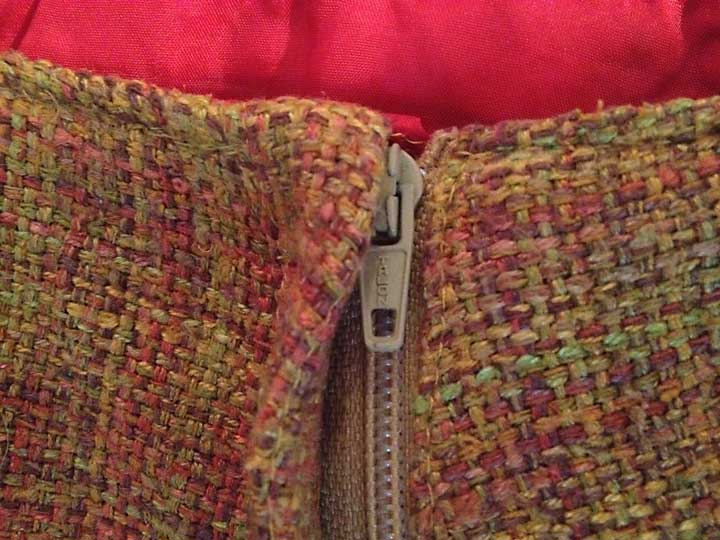
Regular zipper

Example of a regular zipper. Note the nice, big, obvious hole in the zipper pull.

Invisible zipper Example of invisible zipper. Unlike the regular zipper, the pull on this one doesn’t have a hole; the new zipper pull will have to attach to the horseshoe-shaped piece above the pull shown here. Continue reading