Changing Your Clothes

Shopping, Sewing, Upcycling, Repairing: Make the most of your clothes!


3 Comments

At the Salon: Changing More Than My Hair!

I’m sitting at my salon, under a dryer, with more foil wrapping than a Thanksgiving turkey– and have still managed to change someone else’s clothes! (Talk about multi-tasking!)

Details: Silvana, my wonderful stylist, was about to put on her apron when I arrived. She said she thought she’d have to get rid of it, because the Velcro strip (for adjusting the length of the neck strap) was ruining her clothes, snagging everything it touched. I took a look.
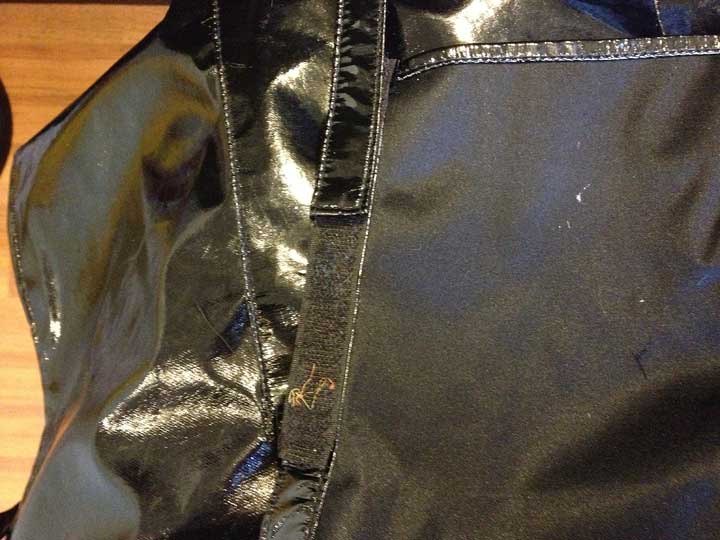
Before: the Velcro strip from hell!

Before: the Velcro strip from hell! You can actually see threads on it where poor Silvana’s clothes got snagged. (You’re looking at the underside of the bib of the apron.)

You can see the Velcro strip here. I thought it would be pretty easy to fix: just remove the part of the strip that was exposed (she’d already adjusted the size). Naturally, she had plenty of scissors, so I got to work.

I carefully snipped each stitch, and voila: In less than 3 minutes, the snagging problem was eliminated!

During: removing the Velcro

During: removing the Velcro. This simply involved snipping the stitches that held it in place, one at a time, being careful not to cut the fabric underneath.

So Silvana’s apron looks fabulous, and it won’t snag her tops! Oh, and I’ll let you know how my hair turns out. ; )
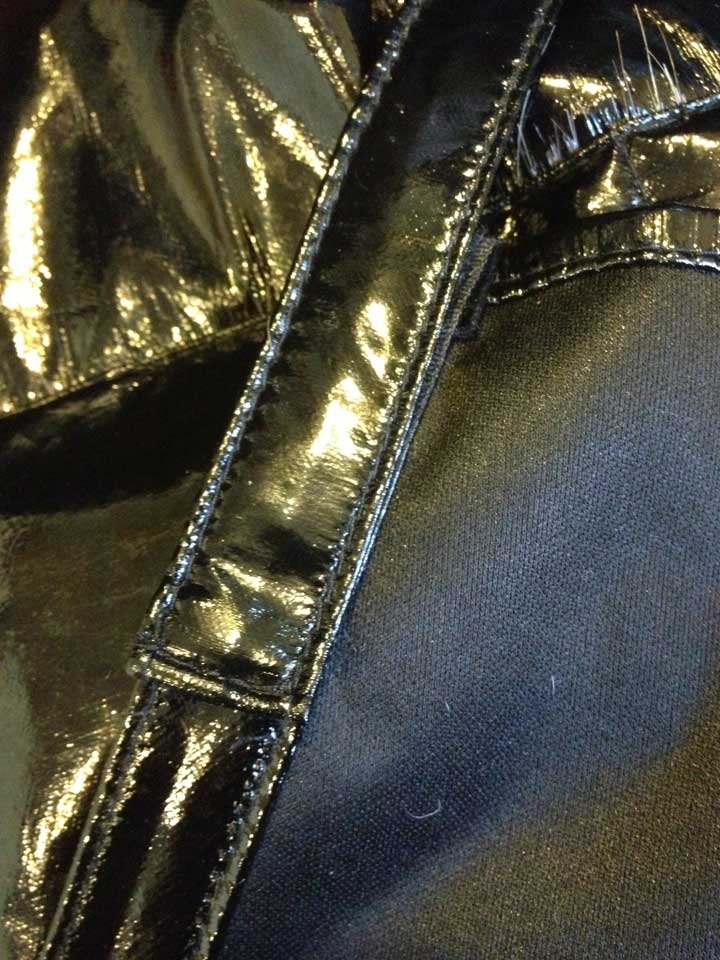
After: Velcro under control!

After: Velcro under control! (It’s still there, under the neck strap shown here; I just removed the excess.)

P.S. My hair looks as fab as Silvana in her apron!


4 Comments

Closet Confessions: How My Trousers Got Their Stripes

Remember my pale sage green linen trousers I made for my Santa Fe travel wardrobe? Well, there’s a reason they have those sporty side stripes— and I’m willing to tell all, purely out of consideration for you, dear readers.

For my sewing friends: have you run into this problem with multi-sized patterns? The one where the size range is, say, 6-14 or 16-22, but you are in between? This is what happened to me with the trouser pattern I used. It went up to a size 14; in ready-to-wear, I’m more like a size 12, but in sewing patterns (which are sized differently), I’m finding that a 14 or 16 is more appropriate, depending on what type of garment it is. (But even that isn’t consistent across pattern brands. Aargh.) When purchasing the pattern, I decided optimistically to get the smaller size range, intending to cut the largest size (14). Which I did.

Problem:  <Deeeep breath>  The trousers were too small. In some fabrics (stretch wovens, for example), this might not have been such an issue, but I was using a substantial linen, and the trousers were cut with wide legs, so I didn’t want the fit to be tight. Aargh encore. Continue reading


5 Comments

Hem My Skirt, Part 2: Happily Hemmed In!

It’s interesting how projects evolve. In Hem My Skirt, Part 1,  my main objective was to cut off the stained lower edge of my white linen skirt, to at least make it wearable (albeit 6.5″ shorter). The challenge was to mark and cut the skirt to its new length— said skirt being bias-cut, with a curving, A-line-verging-on-semi-circular hem. End of Part 1 found us with a newly-trimmed skirt, hanging for a couple of days before hemming (a necessity when working with bias-cut garments).

However, once I started working on preparing the trimmed-and-hung skirt for the sewing of the new hem, I realized that, along with getting rid of the stained part of the old hem, I could also improve on the finishing of the machine-stitched hem. Here’s how it looked originally, folded under twice, then sewn:

Skirt with original hem Skirt with original hem, turned under twice before machine-stitching; note the ripply edge, not a good finish for a bias-cut skirt, in my opinion. We can improve on this. Continue reading


1 Comment

Hem My Skirt, Part 1: A Short (& Biased) Story

I have a white skirt dilemma, and it’s almost Labor Day— I think it now qualifies as an emergency! If I don’t fix this skirt now, I’ll have to bow to the Goddess of Fashion Rules and pack it up until next Memorial Day.

Here’s what’s going on. Last week, when temperatures here in Portland were hovering around 100, I finally fished my one and only white linen skirt out of the ironing pile. (My working theory was that just wearing white linen would give me the psychological advantage over the weather forecast. The jury’s still out.) Well, when I was about to start ironing the skirt, I started to notice a series of strange stains, all more or less near the hemline; strange because they all felt sort of hard, as if wax or something like that had fallen on the skirt and stiffened up. (Don’t ask me how this happened. I’m still scratching my head. I’m thinking these are some of those phantom things that happen in the laundry, much to my mystification.) It’s a little hard to see the stain in this photo,  since it’s more hard than dark, but you can just make it out:

Stain on White Skirt

One of several mysterious stains on my white linen skirt. No amount of soaking or treating seemed to make any difference.

I found stains like this one in several places, but they were all within 5 inches or so of the hem. Now, this skirt is bias-cut, A-line, and (originally) 30″ long from waistband to hem, which translates to mid-calf length on me (I’m over 5’8″ tall). So I thought it might be possible to simply re-hem the skirt to a shorter length, cutting off the offending stain-ridden area. Aha, I thought, I can get rid of the stains and make my skirt a more modern (and flattering) length simultaneously! Brilliant!

Of course, these brilliant ideas often don’t take certain issues into account. As I said, the skirt is bias-cut; this doesn’t necessarily make it more difficult to cut, but the stitching of the new hem will be a little more involved. So for today, I’ll show you how I measured and cut the skirt to its new length, and I’ll cover the finishing (including sewing) in my next post.

What you’ll need:

Something to mark your new hemline before cutting;

sharp shears;

tape measure or ruler;

sewing machine or hand-sewing needle

Okay! First, I’m going to lay my skirt out as smoothly as possible, lining up the front and back hemline edges. (Because I usually photograph things on a white backdrop, I’ve removed the background here so you can see the skirt a bit better.)

Skirt laid flat for cutting My skirt laid flat for cutting. Notice the curve of the hemline. Continue reading


Leave a comment

Zip It, The Epilogue: Non-DIY Zipper Pulls!

Here’s a great place for hand-made zipper pulls: Lubun Bay Jewelry on Etsy!

Lubun Bay zipper pulls/stitch markers

Gwen’s zipper pulls and stitch markers, in her Etsy shop, Lubun Bay Jewelry!

In addition to zipper pulls (for just $2.50!!), Gwen makes beautiful jewelry, and stitch markers for knitting and crochet. And she can make your zipper pull in the color of your choice! Go and visit her on Etsy!

(And if you’d like to try your hand at making your own zipper pulls, check out my super-new tutorial!)


2 Comments

Zip It, The Finale: 5 Easy Steps to a DIY Zipper Pull!

In the short amount of time I spent getting ready this morning for my great DIY zipper pull experiment, I learned several things:

1. I have relatively few clothes with zippers.

2. The ones with zippers are almost all invisible zippers. (This is probably due to my preference when making clothes— I find invisible zippers the easiest to install.)

3. The pulls on invisible zippers vary considerably from those of regular zippers.

Why are these facts important? Well, if you look at the following 2 photos,  you’ll see that the available places where you can connect a new zipper pull are quite different:

Regular zipper

Example of a regular zipper. Note the nice, big, obvious hole in the zipper pull.

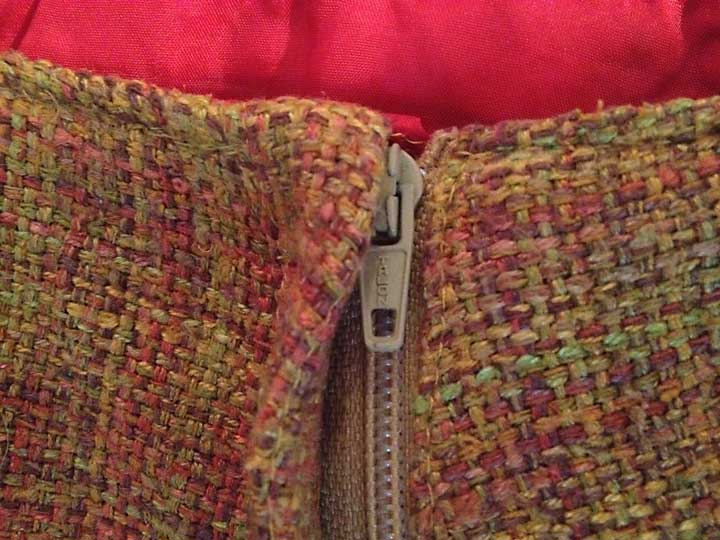
Invisible zipper Example of invisible zipper. Unlike the regular zipper, the pull on this one doesn’t have a hole; the new zipper pull will have to attach to the horseshoe-shaped piece above the pull shown here. Continue reading


Leave a comment

Zip It, Part Deux: DIY Pull?

This is the first part of my follow-up on yesterday’s post on fixing a broken/missing zipper pull (Zip It: The Lost-Pull Fix). The next part will include full instructions for making a zipper pull (hurrah!).

When I needed pliers to open my replacement zipper pull, I grabbed the first ones I could lay my hands on, which happened to be in my jewelry-making supply box. They were right next to a package of lobster-claw clasps, and even though I was in a hurry to get that blog post going, it did occur to me at the time to wonder if those clasps would fit on an ordinary zipper pull. Hmm…

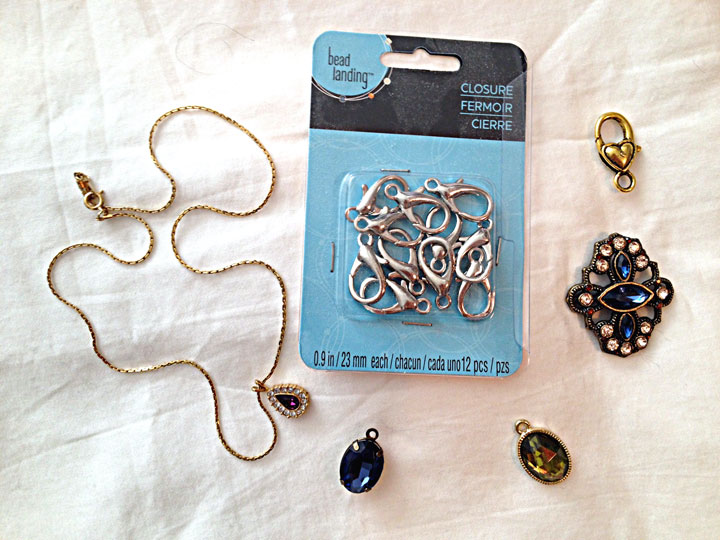
This morning, I took a closer look at my jewelry materials. Here’s the result of a quick rummage through my supplies:

Possible make-your-own-zipper-pull materials, clockwise starting with the package of lobster-claw clasps: a fancier brass lobster-claw clasp, a jeweled pendant, faux peridot pendant, faux sapphire pendant, and an old necklace with a pendant that could be repurposed as a zipper-pull ornament.

Zippers are such utilitarian things, why not dress them up a bit? (For all we know, they suffer from a perpetual sense of inferiority, considering the beautiful buttons, frogs, laces, and other closure types that compete with zippers. A lot of zippers are actually invisible! Honestly… how would you feel?)

Continue reading


1 Comment

Zip it: The Lost-Pull Fix

I just found this cute cotton skirt at my favorite thrift store (Value Village), complete with bohemian print and sequin embellishment, for which I paid the princely sum of $2.50.

Embellished print skirt

Embellished print skirt, found at my favorite thrift store, Value Village.

My general belief is that clothes are given to thrift stores for a reason, whether it’s a fit issue, a stain that won’t come out, or maybe that Bridget Jones-inspired reindeer pullover was a gift you just can’t bring yourself to wear. From what I’ve seen, the most common reason we give clothing away is because there’s something wrong with it that we don’t know how to fix. In this case, my summery little skirt was missing its zipper pull.

Continue reading