In my first follow-up report on my Chicago (ORD) travel wardrobe, I told you about a last-minute fix for a minor packing-related emergency. Now I want to get on to the follow-up proper, starting with showing you exactly what I took with me; as you’ll see, I made some switches from my original plan. I’ll show my outfits, in the order (ORDer?) in which I wore them, and also with details about what I wore them to do. (Just so this post won’t swell to epic proportions, I’ll split this part of my report into 2-3 posts, each covering a few days of my 8-day trip.)
Aside: I should tell you that the reason for my trip was to accompany my mother (after meeting her at the airport in Chicago) through 8 days of driving around a fairly big area of Illinois. I did all the driving, and basically acted as a personal assistant. However, other than my mom’s 60th high school reunion, I had no idea what types of events I’d need to dress for; all I knew was that we were going to spend a lot of time driving, alternated with visiting Mom’s relatives and family friends (most of whom I hadn’t seen for literally decades). I did have some idea of what to expect weather-wise, having lived in Ohio for almost 25 years before moving back to the Pacific Northwest (in a nutshell, humidity and mosquitoes). Since I was really just guessing as to what clothes I would need, I decided the best approach was to make each piece as versatile as possible, namely, separates, coordinated through the development of my wardrobe color palette. End of aside.
Before I flew off to the Great Midwest, this was my wardrobe plan:
Travel wardrobe (theoretical). Clockwise from left: knit/sequin dress, turquoise wedges, chartreuse silk scarf, print jersey top, hand-knitted cotton cowl, asymmetrical bamboo jersey top, charcoal-grey jersey top, green necklace/bracelet, green pumps, chartreuse/teal/aqua kimono sweater, turquoise necklace, fancy earrings, linen tuxedo-striped trousers, flat ankle-tie sandals, cropped jeans, multi-color flat sandals. However…
You’ve heard my original plan for my Chicago (ORD) wardrobe, seen the color palette I developed for it, and how that palette translates into fabrics, as well as clothes and accessories already in my closet. And now, on my last day of preparation, I can at least show you what I’ve been working on for the past 6 planning-and-sewing-filled days. (This will be in the nature of a briefing— emphasis on brief— with many more details to follow after I get home.)
After working out this color palette, my next move was to decide which garments to make with which fabrics.
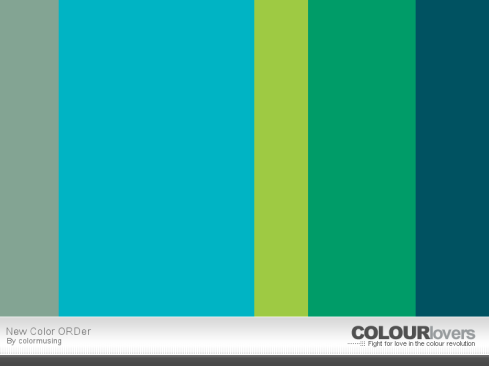
My new ORDer palette. Click on the palette to see it on my ColourLovers page.
Last week, after discovering that I would be heading to Chicago for 8 days, I told you about my initial travel-wardrobe thought process. (This boiled down to the types of pieces I thought I’d need, taking lodging, events, and weather into account.) Since I will be leaving in about a week, my priority now is to create a color palette, so that’s what I’ll focus on today.
Aside: In case my punny use of ORD is causing a raised eyebrow or two, let me explain: ORD is the airport identifier for Chicago’s O’Hare International Airport. It will probably happen again. End of aside.
Changing Your Clothes is primarily about making the most out of what we already have, so that’s what I’ll do first: make over my Santa Fe Wardrobe from last fall. To my closet!
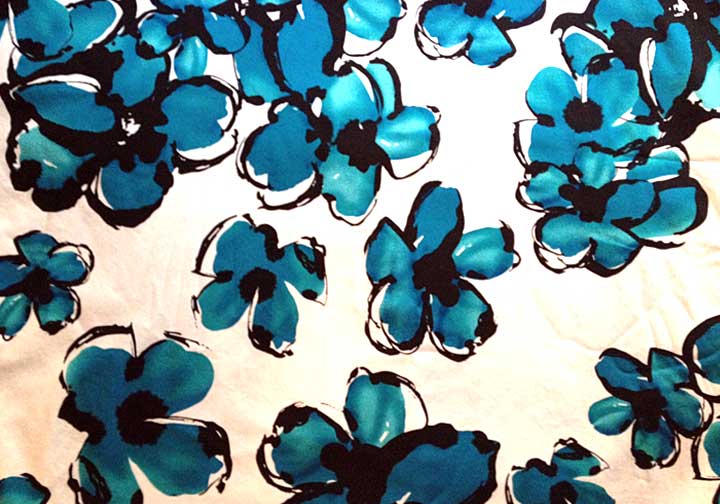
Oh. A funny thing happened on the way to my closet… I got distracted by this piece of fabric, bought just 2 days before I found out about this upcoming trip:
Cotton print fabric. This is a medium-weight cotton with a bit of stretch, but it was the print I couldn’t pass up! (I’m extremely picky about prints.) It’s destined for a vintage-inspired dress.
Much as I do love traveling, between work and, well, work, there were no upcoming trips on my horizon. (I’m watering plants for friends vacationing in Greece at the moment, but that doesn’t really count, except vicariously.)
Until yesterday.
During a casual conversation with my mother, to put a long-ish story in a small-ish nutshell (mixed metaphors and all), I’m now leaving for 8 days in and around Chicago, Illinois— 2 weeks from today!
Map of ORD (Chicago O’Hare International Airport). Okay, I’m not there precisely at this moment, but soon! Map image courtesy of ohare-airport.gov; click on the image to visit this site.
Just in time for warmer weather (ahem… are you listening, Portland?), I give you this wonderful slideshow from Refinery29, featuring summery frocks to rock every figure!
Aside: I have to admit that I’m uncertain which category I fall into; am I a Carrot, an Hourglass, or a Botticelli Babe? (And is it wrong of me to prefer the latter, just because I like the sound of it?) Is a Botticelli Babe a cross between a Carrot and an Hourglass? But seriously… I often find it difficult to put myself definitively into one specific category, but maybe that’s because I don’t like being easily defined. Is it just me? End of aside.
Here’s one of my favorite looks, even though it’s not for my body type (or is it?):
A summer dress for a Carrot. I might just wear this regardless of my body type; it would be flattering on many figures. (Image courtesy of Refinery29. Click on the picture to see the whole slideshow.)
I’m personally most intrigued by the tips for using strategic placement of prints and color-blocking (you know that’s my favorite) to instantly change how you perceive your proportions; looking great in your clothes is, after all, much more about proportion than about size. Really.
Reminder: As of this week, I’ve decided to alternate my Makeover Monday and Thrift-Shop Thursday posts on a weekly basis. This week was Makeover Monday week, so next week, you’ll find a Thrift-Shop Thursday post on (you guessed it) Thursday. Don’t miss it!
In last week’s Thrift-Shop Thursday post, I gave some suggestions for an online version of the thrift-shopping experience (not the same thing, I know, but I tried). Today I’d like to focus on consignment and vintage shops that sell clothing online, and more specifically on those shops that only sell online—at a discount.
First, for the sake of clarity, some definitions:
Consignment is a deal between the owner of an item and a store (brick-and-mortar or online), where the store agrees to sell the item on behalf of the owner, in return for a percentage of the sale. Since the store naturally wants to make a profit, consigned items usually will have higher prices than the average thrift shop. On the other hand, consigned clothing tends to be of much higher quality; often high-end designer pieces find their way into consignment stores, because the owners want to recoup at least a little of their original investment, rather than just give them away.
Vintage is slightly more difficult to define precisely, although the correct usage is a reference to the year something was made (e.g. a VW Bug vintage 1968). Unlike the term antique, which describes items of a minimum age (usually 100 years), vintage generally seems to refer now to almost anything that’s not actually brand-new. However, in this post, let’s assume we’re talking about clothing that’s clearly not from the current fashion era, say, 10 years old or more.
In the interest of keeping this post relatively short, I’m just going to give you one example shop in each category. (If you’d like to look around for more, I used the search terms “online consignment shop”, and “online vintage shop”.) Continue reading →
I was thinking this week about how lucky I am to live near so many fantastic thrift shops, when it suddenly occurred to me to wonder about those of you who don’t. Maybe you live in a rural area, or a residential-only suburb, or perhaps it’s physically difficult to get around. Whatever the issue is, what can you do to feel the thrift-shopping thrill?
What about bargain-hunting online? Okay, maybe clicking and typing is not as visceral an experience as riffling through rack after rack in a thrift or consignment shop, but it’s always exciting to find something beautiful/unique/inspiring— especially when it’s discounted!
So where do you start? There are the usual big-name thrifty suspects, like eBay and Amazon, each with their bargain specialties. On eBay, check out their Daily Deals page; today they’re featuring electronic-related items (including 20% off an iTunes gift card). eBay is also a wonderful source for vintage clothing and collectibles, among many other categories. Personally, I’ve used eBay mostly for buying and selling yarn, fabric, and patterns; there are amazing bargains to be found in these categories.
Since my last Thrift-Shop Thursday post, which focused on finding fabric bargains in the remnant bin, I’ve been thinking about more creative uses for remnants (including pieces gleaned from thrift-shop items). There are so many possibilities that I had to narrow them down to just 2 in this post: garments and accessories that require small amounts of fabric, and color-blocking.
First, let’s define remnants. For me, this includes odd pieces of fabric left over from past sewing projects, as well as the small lengths (usually 2 yards or less) sold as remnants in fabric stores. (Remember the color-blocked top I made entirely out of scrap fabrics?) Remnants could even include parts of garments, like collars or sashes, that have been rescued from otherwise defunct clothes; I think these qualify as remnants because they can be incorporated into new garments as easily as pieces of fabric. And don’t forget about other things that come by the yard, like interfacing, lining fabrics, and trims such as piping, sequins, or fringe; even tiny quantities can make a big impact. You can also rescue beautiful buttons from thrift-shop clothes and reuse them.
Clarification: Although I define remnants pretty loosely, in my posts, when I say “remnants”, I mean pieces that you buy as remnants in a fabric store; “scraps” means pieces you have left over from previous projects, and parts salvaged from old garments.
Tip: How do you decide if a scrap is too small to bother keeping? If you generally make garments, I’d say a scrap that’s at least 12″ x 12″ is worth keeping; it could become a pocket or it could be cut in half to make cuffs, for instance. But if your sewing projects include things like pillows and quilts, a scrap would have to be even smaller than that to give up on it. However, the uses for your scraps will depend on the type of fabric. For example, if what you have left over is small pieces of thick wool coating, well, there may not be much you can do with those, outside of possibly making a clutch purse or something similar that would make sense with that fabric.
Now we’ll get into specific project ideas, starting with garments that require small quantities of fabric.
When you go remnant-shopping at a fabric store, as a general rule of thumb, you’ll probably need at least 1.5 yards to make a simple sleeveless top, if the fabric is 45″ wide, more like 1 yard if it’s 60″ wide.
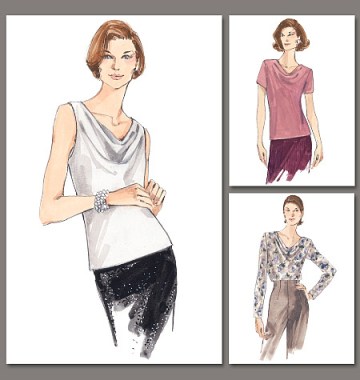
Tip: Since so much pattern information is now available online, it’s easy to get an idea of the yardage you’ll need for various types of garments before you head to the fabric store. Here’s a simple bias-cut top (this is one I’ve made myself) that would work well with a remnant:
Vogue 9771 sewing pattern. The sleeveless version of this bias-cut top only requires 1.5 yards (45″ wide) for a size 12, making it perfect for using a remnant. (Illustration courtesy of Vogue Patterns; click on the picture to see this pattern and all its yardage information.)
With this one pattern, I see so many possibilities! Yes, you can make the entire top with just one fabric, but wouldn’t it be fun to mix 2 different prints or textures? I once made a sheath dress that was plain black in the front, and the entire back was covered in tiny black shimmery sequins. (I’ll have to use that idea again… I miss that dress!) A beautiful floral print for the front, with stripes for the back would be fun; some patterns, like Butterick 5856, might even lend themselves to combining a knit fabric with a woven one.
Tip: When combining different fabrics into one garment, keep 2 things in mind: 1. All fabrics should be of a similar weight. I’d make an exception to this rule if I wanted to use something sheer, like lace, on part of a garment. 2. All fabrics should be laundry-compatible. When you’re sewing your own garment, pre-shrinking your fabrics ensures that your garment won’t end up with one part shrinking more than another.
You can also use a double layer of fabric, such as a sheer fabric that needs a backing, if you want to combine them with a heavier fabric. I did this for my color-blocked top, because the black fabric I used for the back was much heavier than the others, so everything on the front of this top is double-layered. (This turned out to be a great benefit— almost like having built-in shapewear!)
Other small-yardage garments include pencil skirts and shorts (anywhere from 1-2.5 yards, depending on the fabric width and garment size); remnants can also be ideal for many accessory items, like scarves. Here are some patterns for a few less-expected accessories:
Butterick 5695 pattern for gloves. These require only small pieces of fabric, and could easily be made by upcycling thrift-shop leather garments. (Photo courtesy of Butterick; click on the photo to see this pattern.)
McCall’s 6366 apron pattern. Many aprons require less than a yard of fabric. (Photo courtesy of McCall’s; click on the photo to see this pattern.
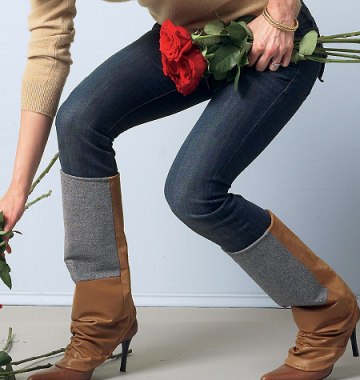
McCall’s 6615 boot-topper pattern. This super-fun pattern includes several different styles, any of which would make good use of scraps or remnants. I saw quite a few remnants of faux suede and leather at a fabric store just the other day, but these could be made out of almost anything. (Photo courtesy of McCall’s; click on the picture to see this pattern.)
These are just a few of the possibilities I ran across in a quick tour around Vogue/Butterick/McCall’s patterns, but let’s move on to color-blocking! I had no difficulty finding patterns that are specifically designed for color-blocking, including some I’ve already made myself, like the knit top I mentioned earlier; you can find that pattern here.
Tip: The main issue when planning a color-blocked garment is figuring out how much fabric you need for each block; if your pattern was created with color-blocking in mind, it should list separate yardage requirements for each one (usually called “Contrast 1”, “Contrast 2”, etc.). However, if you’re starting with a pattern that’s designed for just one fabric, but you want to use more than one, the best thing to do is get your pattern pieces out and measure them, making a list of measurements/yardage for each block; laying out the pieces on some fabric from your stash (I hope I’m not the only one with a stash!) is one of the more accurate ways to assess your yardage requirements.
Now for some of my favorite patterns that are designed for color-blocking:
McCall’s 6435 pattern. I’ve made this myself; it’s simple color-blocking, so it might be a good one to start with. (Photo courtesy of McCall’s; click on the photo to see this pattern.)
McCall’s 6511 pattern. The backs of these tops are all in one fabric (not more than 1.25 yards required), and the fronts have 12-13 different contrast pieces listed, making it easy to know what size pieces you need. You could use a remnant for the back, then gather fabric scraps in various colors and textures for the front! (Photo courtesy of McCall’s; click on the photo to see this pattern.)
Butterick 5852 pattern. This requires a bit more of some fabrics (it’s lined, too), but I think it’s a really interesting use of several different materials. (Photo courtesy of Butterick; click on the photo to see this pattern.)
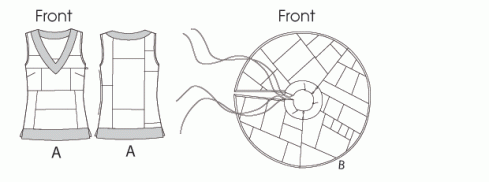
This last one is really intriguing. In the photo, it’s hard to see what’s going on in this color-blocked skirt, so I’ve included the line drawing below to show you the details; I’ve imagined making both pieces with all those tiny-but-too-beautiful-to-toss scraps of lace, sequins, embroidered fabrics, satins…
McCall’s 6712 pattern. This photo doesn’t show the top that’s also included with the skirt pattern (the white top is not part of the pattern), or the details of the skirt, but you can see more in the line drawing below. (Photo and line drawing courtesy of McCall’s; click on the photo or drawing to see this pattern.)
McCall’s 6712 details. The top has 23 blocks, and the skirt has 37! How much fun would it be to play with these patterns? (Click on the picture to see this pattern.)
I have several of these patterns myself, and I’ll be posting photos as I get the garments made. Many of these would work well as TTTW (Take Tango to Work!) pieces, so I’ll probably start with those; the Butterick 5852 dress is a good candidate for using some of my scraps and remnants.
What about you? Do you think you’ll try color-blocking with your own fabric scraps, and/or sewing garments or accessories with remnants? They’re not to everyone’s taste, I admit, but personally, I love creating a color palette, then mixing textures together, for a truly unique look. And projects like these are certainly in keeping with the spirit of Thrift-Shop Thursday, which is not just about finding great deals— it’s about making good use of them. This is especially true when you’re creating your own clothes by combining your fabric scraps with discounted remnants. Now that’s thrifty!
The last 2 TST posts are all about developing your shopping strategy. Part 1 suggests making the prospect less daunting by narrowing your focus before heading to the thrift shop; Part 2 shows how to apply your strategy while shopping. Today, I want to explore the idea of applying thrift-shopping strategy to other types of stores.
I was at one of my favorite fabric stores the other day (Mill End Fabrics, if you happen to be in Portland); I hadn’t been there in quite a while, things were all rearranged, so this was basically a reconnaissance mission, not a buying one. While touring one of my favorite sections (Silks—not usually a source of bargains), I noticed a larger-than-usual display of remnants. It occurred to me that even in a store that’s not a thrift shop per se, bargain-spotting tactics still apply— beyond the usual sales. (This particular store doesn’t have a lot of sales, actually; since it’s stocked with mill ends of designer fabrics, they’re already priced well.)
My thrift-shopping heart beat just a little faster as I approached the remnant display, lured by the subtle glow of silk crepes, georgettes, and charmeuses. (Sorry— there’s something about silk fabrics that makes me talk like that.) I was so entranced that it didn’t occur to me to take a photo of the whole display, but I do at least have some pictures of what I bought. Here’s the whole group:
My new silk remnants! 1. Black & white printed georgette. 2. Berry organdy. 3. Striped crepe de chine. 4. Printed charmeuse. 5. Lavender stretch charmeuse.
Previously on Thrift-Shop Thursday, in Shopping Strategies, Part 1, I suggested developing your shopping strategy before going to a thrift shop; this boils down to getting as clear as possible about what you want. Today, I’ll continue with Part 2, in which I’ll take a sample shopping trip and see how well my Part 1 strategy works (or not)!
In my own Part 1 strategy, I decided that I was going to continue looking for Take Tango to Work! items. However, since this week’s Makeover Monday, where I took the collar off a shirt to use as an accessory, I’ve been thinking about all the possible variations on this theme, so I’ve revised my plan. Here’s my new shopping strategy for this trip, condensing the 3 steps from Part 1:
Pick a priority, make it as specific as possible, then pick a store. My new priority is to find shirts with (a) a collar plus a collar stand, and (b) some sort of visual interest in the collar. This could be just a beautiful color, unusual fabric, or embellishment, like beading, embroidery, or trim. The Value Village store that’s closest to me is enormous, and has a large selection of button-down shirts, so I’ll go there.
Tip: Take a tape measure with you! In thinking about my collar project, I realized that it wouldn’t have to be garment-size-dependent. In other words, I could take a collar off, say, a size 20 shirt (equivalent of XXL), and it would still work; it would just be looser around my neck. (This would make it lie more like a necklace, actually, so if you happen across a beautiful beaded collar on a garment that’s way too big for you, don’t pass it up!) So before I left for Value Village, I measured around the inside of my Makeover Monday collar, which was 15″ when buttoned. This is close-fitting but not tight on my neck, so I’m adding bigger-then-15″ to my strategy.
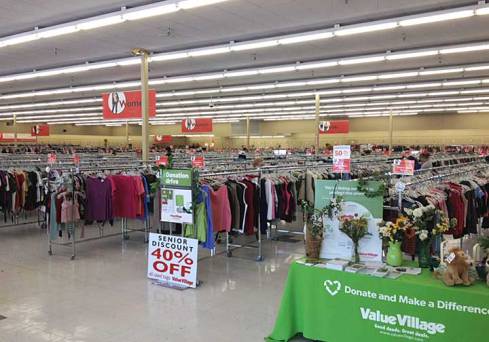
Off to shop! Here’s what my Value Village store looks like:
My local Value Village store. Enormous, non? And this photo doesn’t even show the furniture, housewares, books, etc. Now we can see the value of going in with a plan! (Click on the photo to find your Value Village.)









 Changing Your Clothes