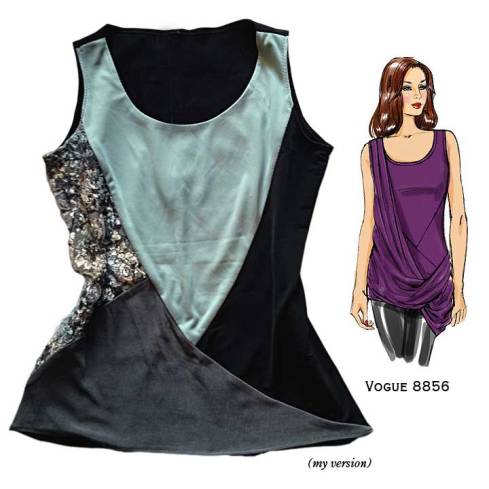
Last weekend, as part of my ongoing effort to expand my dance-class wardrobe, I made myself this stretchy little top:
My new top: my version of this one-color top, View B of Vogue 8856.
Perhaps this is not quite as newsworthy as my jeans’ recent visits to the CYC Day Spa, but there is at least one unique aspect to this project: I made it entirely out of fabric scraps.
Wouldn’t you know it: just when my jeans are getting used to seeing themselves in their new custom color after their first visit to the Changing Your Clothes Day Spa, today they’re back for Phase 2: a little trim! They’ve let me know they’re not ready for a drastic change, so I’ve promised not to cut more than an inch… from each side. Yes, that’s right, they’re going to go from a classic boot cut to straight legs!
The first step in this seemingly simple process is to analyze the current conditions, in order to make a plan; I’ve learned (the hard way) that having a strategy before making that first crucial snip is the key to a successful outcome.
Tip: I realized, only after my jeans’ dye job last week, that it would have been better to do the leg alterations before dyeing the jeans, because guess what? That antique-gold-colored thread used for the topstitching on the inseam and hem got dyed along with the jeans! So the topstitching thread that I bought for this specific purpose won’t match. However, since I’m planning to overdye the jeans with black, I’m hoping the difference in thread color will not be so noticeable by the time this makeover is complete.
Looking at the jeans, I notice that the inseam is topstitched, but the outseam is not.
Original seams: the inseam is topstitched, but the outseam is not.
I know you’ve all been breathlessly waiting to hear the results of my Practical vs. Extravagant question. Wait no longer! (For those of you who are breathlessly confused about what I’m talking about, you might want to read the post that started this great debate.) Here is my finished outfit:
My Extravagant outfit, all dressed up and hoping to dance! The skirt, with its glowing colors and asymmetrical hem (longer on the right side of this photo, shorter on the other side), is sexy without being inappropriate.
Last week, when I was trying to plan a special holiday outfit, toying with various pieces of fabrics and patterns, I found myself in a familiar place of indecision. I had put together a selection of more or less coordinated fabrics from my over-abundant stash: I started with a gorgeous sequinned fabric with cutouts and a fabulous pointy border, which I thought would be most appropriate for a skirt, but this would necessitate some sort of lining. I came up with a tie-dyed georgette which looked wonderful under the sequins, but which was semi-sheer, so I found a bright coral satin for the undermost layer of what was now a 3-layer skirt.
(Those of you with sharp eyes and memories may recognize this satin from my recent post about making a skirt from a custom-fitted muslin; the satin lines that skirt. Good thing I like this stuff— even after making this second skirt, I still have a lot left over!)
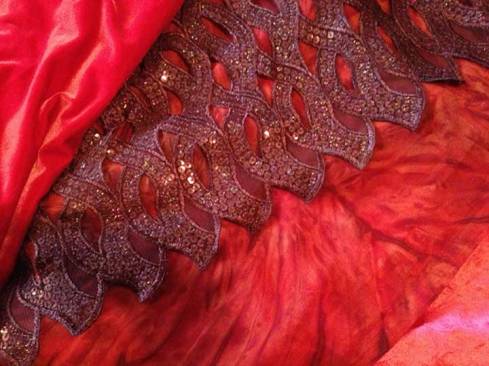
Finally, I added a coral stretch velvet to make a simple top (with all that going on in the skirt, the top really needs to be simple). Here are the four fabrics:
Fabrics for my dancing outfit: The sequinned beauty with the tie-dyed georgette underneath and showing through the cutouts in the sequinned piece, and the satin underneath both (you can see a little of this by itself in the lower right corner). In the upper left corner is the stretch velvet.
Last week I got an almost-last-minute invitation to a cocktail party, and decided it was the perfect time to make a skirt I’ve been thinking about for a while. I already had the fabric: pale grey wool bouclé with tiny clear sequins sewn all over it; I pictured this as the perfect pencil skirt, with a contrast lining that would just peek out from the off-center front slit.
Problem: I didn’t have a pattern for this mythical wonder-skirt, or at least not one that I trusted to fit me.
Since I was in a bit of a rush to get this skirt made, I didn’t photograph the entire process, but I’ll do my best to describe what I did.
First step: After creating my basic skirt design in GD, and plugging in my measurements, I generated a sewing pattern (the software calculates the pattern using my measurements) and printed it out. Obviously it wouldn’t all fit on a letter-sized page, so it automatically tiles the pattern into multiple pages, so all I had to do was tape them together; the patterns print out with handy guidelines to help align the pages properly. (You can see the pattern for the skirt back in the first photo, below). Continue reading →
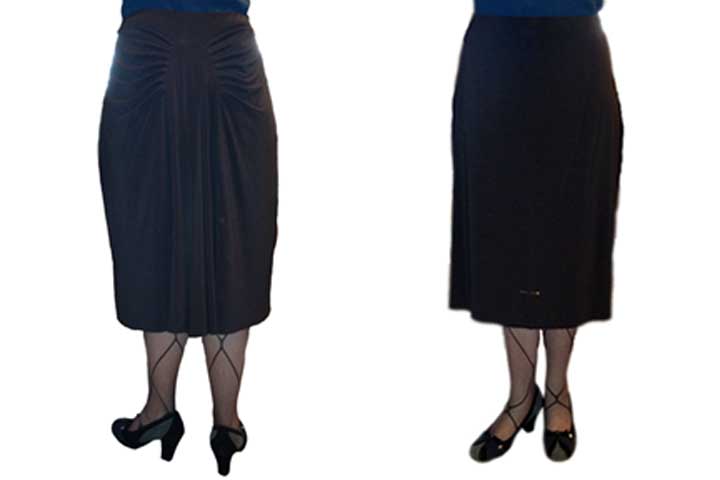
The Tango Skirt. I spotted it languishing on an overcrowded rack in a consignment shop. It flirted shamelessly with me on the hanger, looking all cute and mysterious, and I just knew we would be going home together. I admit, I didn’t know anything about it, really, just that it was the dark, rich brown of the best espresso, in a soft, slinky fabric that was ruched and gathered at the back in an utterly beguiling manner. I didn’t even try it on, just handed over $18.00, and dashed out, clutching it to my heart. It was a magic moment.
Alas, poor Tango Skirt! The magic died when I pulled the skirt on at home. Yes, the ruched-and-fishtailed back was nearly as flattering as it had promised on the hanger, and I loved the way it swished around the backs of my calves. But the front! The front of the skirt, so plain, cut straight and drooping sadly below my knees, was not flattering at all. It was as if I had brought home two different skirts instead of one. Brokenhearted and embarrassed, I hung The Tango Skirt in a dark corner of my closet, where it stayed, unloved, for several months.
The Tango Skirt, pre-alteration. Looking at the plain-Jane front, you’d never guess such fabulousness could be lurking in back! (The pin in the front of the skirt marks the length of the lining, something that’s important to know before you start cutting anything! (Trust me.) Continue reading →
Remember my pale sage green linen trousers I made for my Santa Fe travel wardrobe? Well, there’s a reason they have those sporty side stripes— and I’m willing to tell all, purely out of consideration for you, dear readers.
For my sewing friends: have you run into this problem with multi-sized patterns? The one where the size range is, say, 6-14 or 16-22, but you are in between? This is what happened to me with the trouser pattern I used. It went up to a size 14; in ready-to-wear, I’m more like a size 12, but in sewing patterns (which are sized differently), I’m finding that a 14 or 16 is more appropriate, depending on what type of garment it is. (But even that isn’t consistent across pattern brands. Aargh.) When purchasing the pattern, I decided optimistically to get the smaller size range, intending to cut the largest size (14). Which I did.
Problem: <Deeeep breath> The trousers were too small. In some fabrics (stretch wovens, for example), this might not have been such an issue, but I was using a substantial linen, and the trousers were cut with wide legs, so I didn’t want the fit to be tight. Aargh encore. Continue reading →
As a follow-up to my Santa Fe wardrobe follow-up, I thought you might be interested in a few stats about my Santa Fe travel wardrobe:
1. Out of the 9 main items I packed (not counting swimsuit, sleepwear, etc.), I made 6 of them myself:
a. The deep olive green silk twill Origami skirt;
b. The pale sage green wide-legged linen trousers with deep taupe herringbone racing stripes;
c. The print silk crepe de chine one-shouldered tunic;
d. The cap-sleeved sage-and-lavender-print knit top;
e. The print jersey V-neck dress;
f. The hand-knitted one-sleeved entrelac wrap (also my original design)
(The ones I did not make are the jeans, teal knit top, and asymmetrical print top.)
2. The only things I bought specifically for this wardrobe were the following (everything else I already had, including sewing patterns):
a. Fabrics for the linen trousers and cap-sleeved knit top;
b. The jeans
(I also bought the pewter jersey to line the bronze dress, which ultimately did not make it into my suitcase for this trip. All other fabrics came from my stash.) Continue reading →
I was working on a sewing project the other day, and was changing thread colors on my sewing machine. Without really looking at what I was doing, I set down the sage-green spools I’d been using (laying them behind the machine so they wouldn’t roll off the slightly sloping table). Something back there caught my eye, and I suddenly noticed that I had put the green spools down on top of a zip-top bag with a couple of spools inside it. This is exactly what I saw:
I just love the way these colors look together, but how do you translate that into an actual palette? Go to ColourLovers! (The link will take you to my page on ColourLovers, but feel free to browse the whole site. It’s worth the trip, I promise.) Using this photo as my starting point, I created this palette:
Threads palette created on ColourLovers; note the addition of the white (from the spools) and charcoal grey (from the background of the photo).
When you’re looking at a photo like the one with the threads, the subject matter of the photo can be distracting; it’s often easier to visualize using a color palette when you can see it in solid, flat colors as in the ColourLovers palette.
Why don’t you try creating your own custom palette with a photo? Even photos that are not that great (out of focus, etc.) can be rich sources of beautiful color palettes. You can do this online at ColourLovers, and/or use their palette-creation software, ColorSchemer Studio (they even have a smartphone app version of this!). Have fun! And be sure to post your palettes here for us all to enjoy!
It’s interesting how projects evolve. In Hem My Skirt, Part 1, my main objective was to cut off the stained lower edge of my white linen skirt, to at least make it wearable (albeit 6.5″ shorter). The challenge was to mark and cut the skirt to its new length— said skirt being bias-cut, with a curving, A-line-verging-on-semi-circular hem. End of Part 1 found us with a newly-trimmed skirt, hanging for a couple of days before hemming (a necessity when working with bias-cut garments).
However, once I started working on preparing the trimmed-and-hung skirt for the sewing of the new hem, I realized that, along with getting rid of the stained part of the old hem, I could also improve on the finishing of the machine-stitched hem. Here’s how it looked originally, folded under twice, then sewn:
Skirt with original hem, turned under twice before machine-stitching; note the ripply edge, not a good finish for a bias-cut skirt, in my opinion. We can improve on this. Continue reading →





 Changing Your Clothes