Since my last Thrift-Shop Thursday post, which focused on finding fabric bargains in the remnant bin, I’ve been thinking about more creative uses for remnants (including pieces gleaned from thrift-shop items). There are so many possibilities that I had to narrow them down to just 2 in this post: garments and accessories that require small amounts of fabric, and color-blocking.
First, let’s define remnants. For me, this includes odd pieces of fabric left over from past sewing projects, as well as the small lengths (usually 2 yards or less) sold as remnants in fabric stores. (Remember the color-blocked top I made entirely out of scrap fabrics?) Remnants could even include parts of garments, like collars or sashes, that have been rescued from otherwise defunct clothes; I think these qualify as remnants because they can be incorporated into new garments as easily as pieces of fabric. And don’t forget about other things that come by the yard, like interfacing, lining fabrics, and trims such as piping, sequins, or fringe; even tiny quantities can make a big impact. You can also rescue beautiful buttons from thrift-shop clothes and reuse them.
Clarification: Although I define remnants pretty loosely, in my posts, when I say “remnants”, I mean pieces that you buy as remnants in a fabric store; “scraps” means pieces you have left over from previous projects, and parts salvaged from old garments.
Tip: How do you decide if a scrap is too small to bother keeping? If you generally make garments, I’d say a scrap that’s at least 12″ x 12″ is worth keeping; it could become a pocket or it could be cut in half to make cuffs, for instance. But if your sewing projects include things like pillows and quilts, a scrap would have to be even smaller than that to give up on it. However, the uses for your scraps will depend on the type of fabric. For example, if what you have left over is small pieces of thick wool coating, well, there may not be much you can do with those, outside of possibly making a clutch purse or something similar that would make sense with that fabric.
Now we’ll get into specific project ideas, starting with garments that require small quantities of fabric.
When you go remnant-shopping at a fabric store, as a general rule of thumb, you’ll probably need at least 1.5 yards to make a simple sleeveless top, if the fabric is 45″ wide, more like 1 yard if it’s 60″ wide.
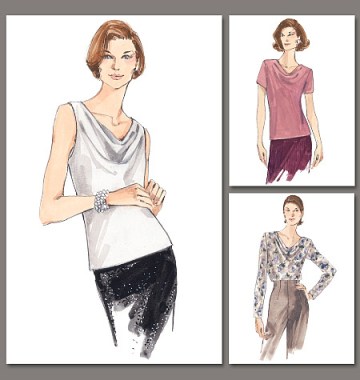
Tip: Since so much pattern information is now available online, it’s easy to get an idea of the yardage you’ll need for various types of garments before you head to the fabric store. Here’s a simple bias-cut top (this is one I’ve made myself) that would work well with a remnant:
Vogue 9771 sewing pattern. The sleeveless version of this bias-cut top only requires 1.5 yards (45″ wide) for a size 12, making it perfect for using a remnant. (Illustration courtesy of Vogue Patterns; click on the picture to see this pattern and all its yardage information.)
With this one pattern, I see so many possibilities! Yes, you can make the entire top with just one fabric, but wouldn’t it be fun to mix 2 different prints or textures? I once made a sheath dress that was plain black in the front, and the entire back was covered in tiny black shimmery sequins. (I’ll have to use that idea again… I miss that dress!) A beautiful floral print for the front, with stripes for the back would be fun; some patterns, like Butterick 5856, might even lend themselves to combining a knit fabric with a woven one.
Tip: When combining different fabrics into one garment, keep 2 things in mind: 1. All fabrics should be of a similar weight. I’d make an exception to this rule if I wanted to use something sheer, like lace, on part of a garment. 2. All fabrics should be laundry-compatible. When you’re sewing your own garment, pre-shrinking your fabrics ensures that your garment won’t end up with one part shrinking more than another.
You can also use a double layer of fabric, such as a sheer fabric that needs a backing, if you want to combine them with a heavier fabric. I did this for my color-blocked top, because the black fabric I used for the back was much heavier than the others, so everything on the front of this top is double-layered. (This turned out to be a great benefit— almost like having built-in shapewear!)
Other small-yardage garments include pencil skirts and shorts (anywhere from 1-2.5 yards, depending on the fabric width and garment size); remnants can also be ideal for many accessory items, like scarves. Here are some patterns for a few less-expected accessories:
Butterick 5695 pattern for gloves. These require only small pieces of fabric, and could easily be made by upcycling thrift-shop leather garments. (Photo courtesy of Butterick; click on the photo to see this pattern.)
McCall’s 6366 apron pattern. Many aprons require less than a yard of fabric. (Photo courtesy of McCall’s; click on the photo to see this pattern.
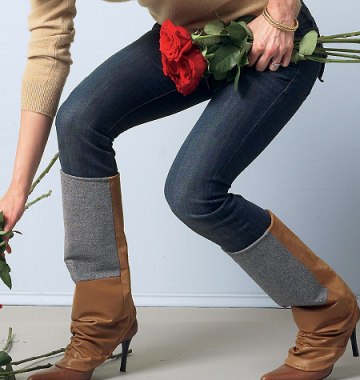
McCall’s 6615 boot-topper pattern. This super-fun pattern includes several different styles, any of which would make good use of scraps or remnants. I saw quite a few remnants of faux suede and leather at a fabric store just the other day, but these could be made out of almost anything. (Photo courtesy of McCall’s; click on the picture to see this pattern.)
These are just a few of the possibilities I ran across in a quick tour around Vogue/Butterick/McCall’s patterns, but let’s move on to color-blocking! I had no difficulty finding patterns that are specifically designed for color-blocking, including some I’ve already made myself, like the knit top I mentioned earlier; you can find that pattern here.
Tip: The main issue when planning a color-blocked garment is figuring out how much fabric you need for each block; if your pattern was created with color-blocking in mind, it should list separate yardage requirements for each one (usually called “Contrast 1”, “Contrast 2”, etc.). However, if you’re starting with a pattern that’s designed for just one fabric, but you want to use more than one, the best thing to do is get your pattern pieces out and measure them, making a list of measurements/yardage for each block; laying out the pieces on some fabric from your stash (I hope I’m not the only one with a stash!) is one of the more accurate ways to assess your yardage requirements.
Now for some of my favorite patterns that are designed for color-blocking:
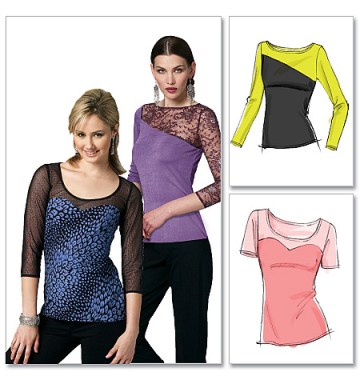
McCall’s 6435 pattern. I’ve made this myself; it’s simple color-blocking, so it might be a good one to start with. (Photo courtesy of McCall’s; click on the photo to see this pattern.)
McCall’s 6511 pattern. The backs of these tops are all in one fabric (not more than 1.25 yards required), and the fronts have 12-13 different contrast pieces listed, making it easy to know what size pieces you need. You could use a remnant for the back, then gather fabric scraps in various colors and textures for the front! (Photo courtesy of McCall’s; click on the photo to see this pattern.)
Butterick 5852 pattern. This requires a bit more of some fabrics (it’s lined, too), but I think it’s a really interesting use of several different materials. (Photo courtesy of Butterick; click on the photo to see this pattern.)
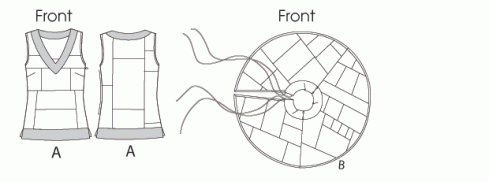
This last one is really intriguing. In the photo, it’s hard to see what’s going on in this color-blocked skirt, so I’ve included the line drawing below to show you the details; I’ve imagined making both pieces with all those tiny-but-too-beautiful-to-toss scraps of lace, sequins, embroidered fabrics, satins…
McCall’s 6712 pattern. This photo doesn’t show the top that’s also included with the skirt pattern (the white top is not part of the pattern), or the details of the skirt, but you can see more in the line drawing below. (Photo and line drawing courtesy of McCall’s; click on the photo or drawing to see this pattern.)
McCall’s 6712 details. The top has 23 blocks, and the skirt has 37! How much fun would it be to play with these patterns? (Click on the picture to see this pattern.)
I have several of these patterns myself, and I’ll be posting photos as I get the garments made. Many of these would work well as TTTW (Take Tango to Work!) pieces, so I’ll probably start with those; the Butterick 5852 dress is a good candidate for using some of my scraps and remnants.
What about you? Do you think you’ll try color-blocking with your own fabric scraps, and/or sewing garments or accessories with remnants? They’re not to everyone’s taste, I admit, but personally, I love creating a color palette, then mixing textures together, for a truly unique look. And projects like these are certainly in keeping with the spirit of Thrift-Shop Thursday, which is not just about finding great deals— it’s about making good use of them. This is especially true when you’re creating your own clothes by combining your fabric scraps with discounted remnants. Now that’s thrifty!
For the past 2 Makeover Mondays, I’ve been experimenting to see how many things I could make from a single shirt. First, I took the collar off to wear on its own, then I tried making a sort of cowl/scarf hybrid with the body of the shirt. And today, I have a quick and easy project to make with the shirt sleeves!
I’ve had a number of ideas for using the shirt sleeves, but I’ve narrowed it down to my favorite, the concept of which is to make a scarf that, when worn, looks like you’ve draped a jacket or cardigan over your shoulders, you know, with the sleeves hanging down in front, or maybe loosely tied. That’s the idea, anyway.
Let’s start by taking a look at what’s left of my increasingly-cannibalized shirt:
What’s left of my shirt, after taking off the collar and the body below the arms. Hmm, it does kind of look like a shrug…
Last week on Makeover Monday, I showed you how to remove a collar from a button-down shirt, and finish the raw edges to create a fun, versatile accessory piece. Today, I decided to experiment with the rest of that shirt. We’ll see how this turns out…
Faced with the raw-edged remains of my now collarless-shirt, I thought I should at least give it a chance at a new life. After all, it’s a nice-quality, soft, lightweight cotton in a beautiful coral-meets-terracotta color, and it’s only the collar that’s gone:
After last week’s Thrift-Shop Thursday’s big debut (featuring the ever-popular replace-a-button tutorial), it occurred to me that it might be a good idea to talk shopping strategies for a minute, before going on to more thrift-shop-find projects.
Tip: These strategies, while thrift-shop-specific in this post, can also apply to any clothes shopping you do; the only real difference between the two is that you’ll have more size options outside of thrift shops.
Rather than just giving you a list of general shopping concepts, I’m going to use my current Makeover Monday/Take Tango to Work series to illustrate these principles in action. In my last MM post, I talked about how to organize a plan to develop a multi-functional wardrobe; here, I’ll follow up on those steps with details, including how I’m putting my own plan to good use at my favorite thrift shops.
Starting with your general plan, you’ll get a bit more specific:
1. Decide what types of garments are your immediate priority. Do you desperately need skirts? Maybe you’re short on trousers, or need more simple tops that can be worn alone or as layering pieces. From here, get even more specific, if possible: black knee-length skirt, classic navy wool trousers, colorful printed knit pullover tops.
What I’m doing: Since I need clothes that can go from work to tango (see my recent Makeover Monday posts for details), I’m focusing my shopping efforts on skirts and dresses, specifically, pencil skirts and sheath dresses, both of which are commonly worn in Argentine tango, and both of which are also work-appropriate. And I need professional-looking jackets and more colorful tops (I’m getting tired of black). I’m also adding a “wild card” space to my list, to cover those unexpected finds, like my pinstriped skirt that I found while shopping for tops. Continue reading →
Previously on Makeover Monday, I showed you the beginnings of my Take Tango to Work (TTTW) wardrobe, thanks to a fantastic find at one of my favorite thrift shops. I also concluded that, to make my tango wardrobe work-appropriate (and vice-versa), I should focus on professional fabrics and colors, and wear them in tango-ready silhouettes. Now that I’ve started sewing a few things based on that general concept, today we’ll be talking about how to choose patterns for maximum garment versatility. And I’ll show you a fabulous skirt I’ve just made, in 2 outfit variations: Professional Lindy and Tango Lindy!
Since I’ve decided a new skirt is a top wardrobe priority, my first step was finding the right pattern. I was lucky enough to find this in my pattern collection:
Butterick 4859 skirt pattern. I made Version B. Sadly, this pattern is now out of print, but I found this one that’s similar (and still available): Vogue 7937.
Because I’ve been making clothes nearly all my life, sometimes I forget that certain skills are not, in fact, second nature to everyone. Even so-called basic sewing techniques involve specific instructions, as I discovered this week when I had to fix a dress whose hem had started to come undone. Just photographing the various steps in the process of hand-sewing approximately 11″ was eye-opening— there’s a lot to this seemingly simple repair!
Here’s the situation: It’s a sheath dress in a substantial stable knit, meaning it has some give, but also holds its shape; this quality has to be taken into consideration, as I’ll show you in a bit. Somehow, between the last time I wore it and, well, now, the hem started unraveling between a side seam and the center back seam. (This is a ready-to-wear dress, originally hemmed with the commonly-used clear monofilament that doesn’t tend to wear very well.)
The hem of my dress coming undone. For such a small section to be restitched, it’s actually quite a project.
Ever since I made my first 3D scarf for last week’s Makeover Monday, I’ve been wearing it almost every day. It’s the perfect light-yet-warm layer that goes on easily over everything. (I’m wearing it even as I type right now!) In fact, this surprisingly versatile piece has gotten so much use already that it inspired me to root through more than my scarf collection for makeover candidates. And lo! Lurking deep in a stack of seldom-worn hand-knitted sweaters, I found this:
Cardi-Wrap, pre-makeover. This is literally just a long, wide scarf with sleeves set into the rectangle.
Previously on Makeover Monday:A pair of too-short jeans gets a glam fix with the addition of deep hem bands in bronze-metallic-finished denim! But when I discovered I didn’t have enough of the contrast fabric to do a double-layer cuff, I got to thinking…
What if I added a different fabric to line the cuff? Then, in addition to the full-length look with the bronze bands, I could fold the cuffs up to capri length, showing the second fabric, and have a whole new look! I thought about the type of fabric for a minute; my first instinct (as usual) was to use something fabulous in sequins (I have lots of scraps under this heading), but I reflected that that might not feel too comfortable against my shins when I wear the jeans at full length. (Boo.) A quick rummage through my stash yielded this:
Fabric to line the bronze cuffs: The new fabric (on right) is printed to look like lace, and I think it’s a great complement to both the original denim and the bronze band.
I confess to a fashion crime… my narrow-leg jeans are just a tiny bit too short. Usually, with a narrower leg, I can get away with a “regular” length, meaning a 31-32″ inseam; with wider legs like boot-cuts, I’d have to go to a “tall” or “long” length (33-34″ inseam). These jeans seemed perfect at first, but after a solid 2 years of a lot of wearing and washing, they’ve gradually gotten a little shorter, to the point where I can only (barely) get away with wearing them with high heels; with flats, they’re maybe 3/4″ too short, at least to my eye. What to do, what to do…
When I was in the fabric store a few weeks ago (getting more dye for my other jeans’ makeover), this idea popped into my head: why not add a contrast band or cuff to the legs of my jeans to lengthen them?
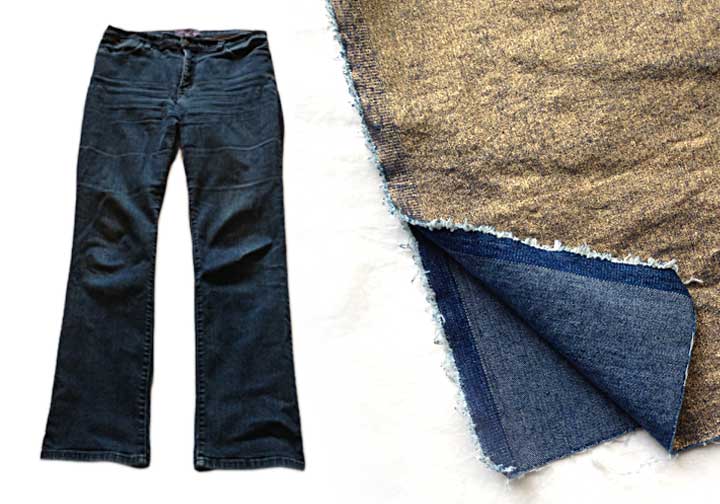
In spite of a rather bewildering array of denim fabric choices, I couldn’t find the black denim I wanted, but I did find an intriguing piece with a bronze metallic finish on one side, very like the lacquered treatments so popular in denim right now. Here are my jeans in their sad “before” condition, and the fabric I found to cuff ’em:
“Before” jeans and bronze-finish denim for cuffs. (These are not the same jeans as the ones I dyed on previous Makeover Mondays, by the way. Now I’m starting to think my whole denim wardrobe is just sad…)







 Changing Your Clothes