The very day that I wrote my May 23 Thrift-Shop Thursday post, which included a section on color-blocking with fabric remnants, guess what arrived in the mail? My Women’s Wear Daily, featuring a color-blocked gown from Christian Dior’s newest Resort 2014 collection! Here it is:
Christian Dior color-blocked dress. I love the mix of fabrics, as well as the use of color. Personally, I’d line that lace panel, though. I’m just saying. (Photo courtesy of Style.com; click on the photo to see this dress in the Resort 2014 collection slideshow.)
This dress perfectly illustrates my suggestion of mixing textures as well as colors, when planning a color-blocked garment. (Although the silhouette is different in Butterick 5852, one of the dress patterns I showed in the last TST post, it’s remarkably similar to this Dior dress, in the way color-blocking is used vertically.) And how fun would it be to create your own original version of this breathtaking designer dress— especially if you could do it with fabric scraps and remnants?
Click here to see the slideshow of the entire Christian Dior Resort 2014 collection, in which you’ll find many examples of artistic color-blocking, from a simple contrast-color waistband on a pair of pants to structured daytime dresses. I hope this inspires you as much as it does me!
Since my last Thrift-Shop Thursday post, which focused on finding fabric bargains in the remnant bin, I’ve been thinking about more creative uses for remnants (including pieces gleaned from thrift-shop items). There are so many possibilities that I had to narrow them down to just 2 in this post: garments and accessories that require small amounts of fabric, and color-blocking.
First, let’s define remnants. For me, this includes odd pieces of fabric left over from past sewing projects, as well as the small lengths (usually 2 yards or less) sold as remnants in fabric stores. (Remember the color-blocked top I made entirely out of scrap fabrics?) Remnants could even include parts of garments, like collars or sashes, that have been rescued from otherwise defunct clothes; I think these qualify as remnants because they can be incorporated into new garments as easily as pieces of fabric. And don’t forget about other things that come by the yard, like interfacing, lining fabrics, and trims such as piping, sequins, or fringe; even tiny quantities can make a big impact. You can also rescue beautiful buttons from thrift-shop clothes and reuse them.
Clarification: Although I define remnants pretty loosely, in my posts, when I say “remnants”, I mean pieces that you buy as remnants in a fabric store; “scraps” means pieces you have left over from previous projects, and parts salvaged from old garments.
Tip: How do you decide if a scrap is too small to bother keeping? If you generally make garments, I’d say a scrap that’s at least 12″ x 12″ is worth keeping; it could become a pocket or it could be cut in half to make cuffs, for instance. But if your sewing projects include things like pillows and quilts, a scrap would have to be even smaller than that to give up on it. However, the uses for your scraps will depend on the type of fabric. For example, if what you have left over is small pieces of thick wool coating, well, there may not be much you can do with those, outside of possibly making a clutch purse or something similar that would make sense with that fabric.
Now we’ll get into specific project ideas, starting with garments that require small quantities of fabric.
When you go remnant-shopping at a fabric store, as a general rule of thumb, you’ll probably need at least 1.5 yards to make a simple sleeveless top, if the fabric is 45″ wide, more like 1 yard if it’s 60″ wide.
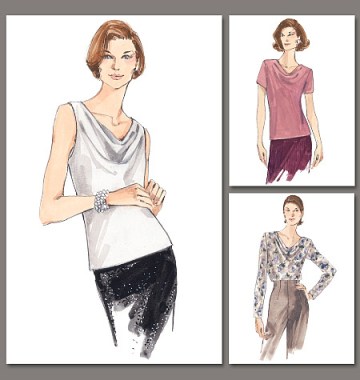
Tip: Since so much pattern information is now available online, it’s easy to get an idea of the yardage you’ll need for various types of garments before you head to the fabric store. Here’s a simple bias-cut top (this is one I’ve made myself) that would work well with a remnant:
Vogue 9771 sewing pattern. The sleeveless version of this bias-cut top only requires 1.5 yards (45″ wide) for a size 12, making it perfect for using a remnant. (Illustration courtesy of Vogue Patterns; click on the picture to see this pattern and all its yardage information.)
With this one pattern, I see so many possibilities! Yes, you can make the entire top with just one fabric, but wouldn’t it be fun to mix 2 different prints or textures? I once made a sheath dress that was plain black in the front, and the entire back was covered in tiny black shimmery sequins. (I’ll have to use that idea again… I miss that dress!) A beautiful floral print for the front, with stripes for the back would be fun; some patterns, like Butterick 5856, might even lend themselves to combining a knit fabric with a woven one.
Tip: When combining different fabrics into one garment, keep 2 things in mind: 1. All fabrics should be of a similar weight. I’d make an exception to this rule if I wanted to use something sheer, like lace, on part of a garment. 2. All fabrics should be laundry-compatible. When you’re sewing your own garment, pre-shrinking your fabrics ensures that your garment won’t end up with one part shrinking more than another.
You can also use a double layer of fabric, such as a sheer fabric that needs a backing, if you want to combine them with a heavier fabric. I did this for my color-blocked top, because the black fabric I used for the back was much heavier than the others, so everything on the front of this top is double-layered. (This turned out to be a great benefit— almost like having built-in shapewear!)
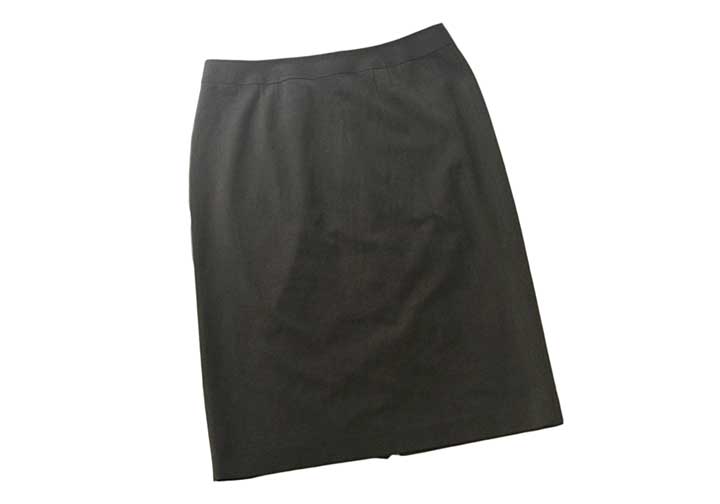
Other small-yardage garments include pencil skirts and shorts (anywhere from 1-2.5 yards, depending on the fabric width and garment size); remnants can also be ideal for many accessory items, like scarves. Here are some patterns for a few less-expected accessories:
Butterick 5695 pattern for gloves. These require only small pieces of fabric, and could easily be made by upcycling thrift-shop leather garments. (Photo courtesy of Butterick; click on the photo to see this pattern.)
McCall’s 6366 apron pattern. Many aprons require less than a yard of fabric. (Photo courtesy of McCall’s; click on the photo to see this pattern.
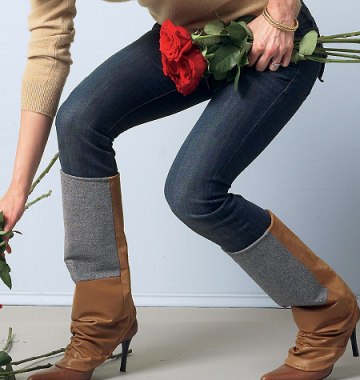
McCall’s 6615 boot-topper pattern. This super-fun pattern includes several different styles, any of which would make good use of scraps or remnants. I saw quite a few remnants of faux suede and leather at a fabric store just the other day, but these could be made out of almost anything. (Photo courtesy of McCall’s; click on the picture to see this pattern.)
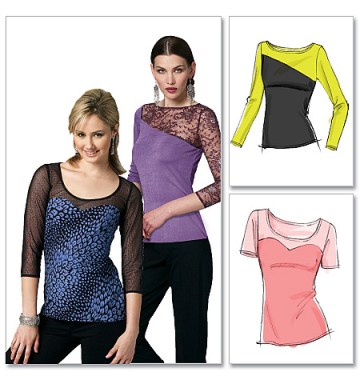
These are just a few of the possibilities I ran across in a quick tour around Vogue/Butterick/McCall’s patterns, but let’s move on to color-blocking! I had no difficulty finding patterns that are specifically designed for color-blocking, including some I’ve already made myself, like the knit top I mentioned earlier; you can find that pattern here.
Tip: The main issue when planning a color-blocked garment is figuring out how much fabric you need for each block; if your pattern was created with color-blocking in mind, it should list separate yardage requirements for each one (usually called “Contrast 1”, “Contrast 2”, etc.). However, if you’re starting with a pattern that’s designed for just one fabric, but you want to use more than one, the best thing to do is get your pattern pieces out and measure them, making a list of measurements/yardage for each block; laying out the pieces on some fabric from your stash (I hope I’m not the only one with a stash!) is one of the more accurate ways to assess your yardage requirements.
Now for some of my favorite patterns that are designed for color-blocking:
McCall’s 6435 pattern. I’ve made this myself; it’s simple color-blocking, so it might be a good one to start with. (Photo courtesy of McCall’s; click on the photo to see this pattern.)
McCall’s 6511 pattern. The backs of these tops are all in one fabric (not more than 1.25 yards required), and the fronts have 12-13 different contrast pieces listed, making it easy to know what size pieces you need. You could use a remnant for the back, then gather fabric scraps in various colors and textures for the front! (Photo courtesy of McCall’s; click on the photo to see this pattern.)
Butterick 5852 pattern. This requires a bit more of some fabrics (it’s lined, too), but I think it’s a really interesting use of several different materials. (Photo courtesy of Butterick; click on the photo to see this pattern.)
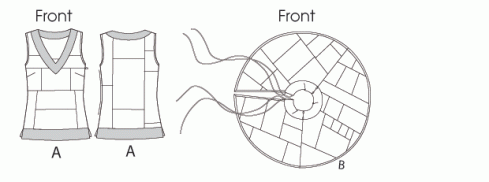
This last one is really intriguing. In the photo, it’s hard to see what’s going on in this color-blocked skirt, so I’ve included the line drawing below to show you the details; I’ve imagined making both pieces with all those tiny-but-too-beautiful-to-toss scraps of lace, sequins, embroidered fabrics, satins…
McCall’s 6712 pattern. This photo doesn’t show the top that’s also included with the skirt pattern (the white top is not part of the pattern), or the details of the skirt, but you can see more in the line drawing below. (Photo and line drawing courtesy of McCall’s; click on the photo or drawing to see this pattern.)
McCall’s 6712 details. The top has 23 blocks, and the skirt has 37! How much fun would it be to play with these patterns? (Click on the picture to see this pattern.)
I have several of these patterns myself, and I’ll be posting photos as I get the garments made. Many of these would work well as TTTW (Take Tango to Work!) pieces, so I’ll probably start with those; the Butterick 5852 dress is a good candidate for using some of my scraps and remnants.
What about you? Do you think you’ll try color-blocking with your own fabric scraps, and/or sewing garments or accessories with remnants? They’re not to everyone’s taste, I admit, but personally, I love creating a color palette, then mixing textures together, for a truly unique look. And projects like these are certainly in keeping with the spirit of Thrift-Shop Thursday, which is not just about finding great deals— it’s about making good use of them. This is especially true when you’re creating your own clothes by combining your fabric scraps with discounted remnants. Now that’s thrifty!
For the past 2 Makeover Mondays, I’ve been experimenting to see how many things I could make from a single shirt. First, I took the collar off to wear on its own, then I tried making a sort of cowl/scarf hybrid with the body of the shirt. And today, I have a quick and easy project to make with the shirt sleeves!
I’ve had a number of ideas for using the shirt sleeves, but I’ve narrowed it down to my favorite, the concept of which is to make a scarf that, when worn, looks like you’ve draped a jacket or cardigan over your shoulders, you know, with the sleeves hanging down in front, or maybe loosely tied. That’s the idea, anyway.
Let’s start by taking a look at what’s left of my increasingly-cannibalized shirt:
What’s left of my shirt, after taking off the collar and the body below the arms. Hmm, it does kind of look like a shrug…
The last 2 TST posts are all about developing your shopping strategy. Part 1 suggests making the prospect less daunting by narrowing your focus before heading to the thrift shop; Part 2 shows how to apply your strategy while shopping. Today, I want to explore the idea of applying thrift-shopping strategy to other types of stores.
I was at one of my favorite fabric stores the other day (Mill End Fabrics, if you happen to be in Portland); I hadn’t been there in quite a while, things were all rearranged, so this was basically a reconnaissance mission, not a buying one. While touring one of my favorite sections (Silks—not usually a source of bargains), I noticed a larger-than-usual display of remnants. It occurred to me that even in a store that’s not a thrift shop per se, bargain-spotting tactics still apply— beyond the usual sales. (This particular store doesn’t have a lot of sales, actually; since it’s stocked with mill ends of designer fabrics, they’re already priced well.)
My thrift-shopping heart beat just a little faster as I approached the remnant display, lured by the subtle glow of silk crepes, georgettes, and charmeuses. (Sorry— there’s something about silk fabrics that makes me talk like that.) I was so entranced that it didn’t occur to me to take a photo of the whole display, but I do at least have some pictures of what I bought. Here’s the whole group:
My new silk remnants! 1. Black & white printed georgette. 2. Berry organdy. 3. Striped crepe de chine. 4. Printed charmeuse. 5. Lavender stretch charmeuse.
Last week on Makeover Monday, I showed you how to remove a collar from a button-down shirt, and finish the raw edges to create a fun, versatile accessory piece. Today, I decided to experiment with the rest of that shirt. We’ll see how this turns out…
Faced with the raw-edged remains of my now collarless-shirt, I thought I should at least give it a chance at a new life. After all, it’s a nice-quality, soft, lightweight cotton in a beautiful coral-meets-terracotta color, and it’s only the collar that’s gone:
Previously on Makeover Monday, I showed you a skirt that I made to go from work to tango dancing. This week, I’ve got something a little different for you: a quick and easy upcycled accessory project! Read on…
Remember the necklaces shaped like collars that were so popular last fall and winter? Personally, I still love them, especially the ones that are made at least in part with fabric, so they almost look like actual collars. And the other day, I was sifting through a pile (one of many) of pictures I’ve snipped out of various publications, trying to choose some for one of my mood boards, when I ran across a photo of a bejeweled faux-collar necklace, with this note scribbled on it: “real collar, wear like necklace”.
I often find my somewhat cryptic notes in unexpected places, and don’t always remember exactly what I was getting at, but this doesn’t really bother me; these notes always spark at least a few ideas, even if they’re totally different from the original inspiration. In this case, I suspect I was thinking of sewing a fabric collar from scratch, but when I read the note, my first thought was to make it even simpler: take a collar off an existing shirt. Great idea!
Problem: I don’t actually own that type of shirt. At least there are none in my closet at this moment. But I dug through my big clothes-to-be-made-over bag, and look what I found:
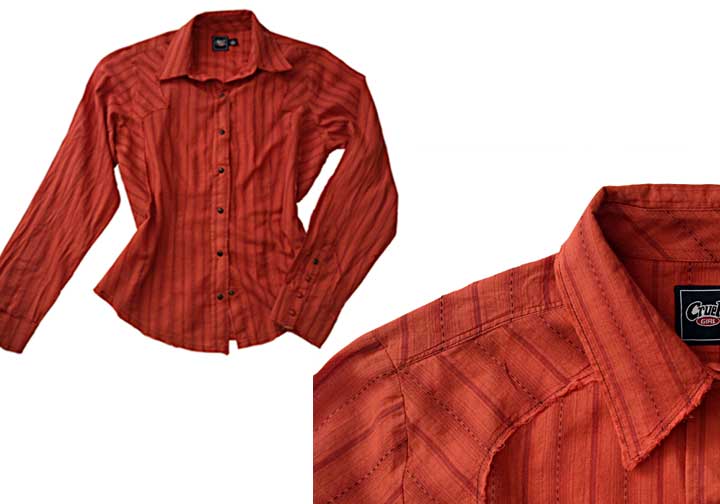
My “before” shirt: lightweight cotton with intentionally frayed edges, Western-style. (Don’t judge me: I bought this in Nevada to wear to my first real rodeo. At least it’s a good color.)
Previously on Makeover Monday, I showed you the beginnings of my Take Tango to Work (TTTW) wardrobe, thanks to a fantastic find at one of my favorite thrift shops. I also concluded that, to make my tango wardrobe work-appropriate (and vice-versa), I should focus on professional fabrics and colors, and wear them in tango-ready silhouettes. Now that I’ve started sewing a few things based on that general concept, today we’ll be talking about how to choose patterns for maximum garment versatility. And I’ll show you a fabulous skirt I’ve just made, in 2 outfit variations: Professional Lindy and Tango Lindy!
Since I’ve decided a new skirt is a top wardrobe priority, my first step was finding the right pattern. I was lucky enough to find this in my pattern collection:
Butterick 4859 skirt pattern. I made Version B. Sadly, this pattern is now out of print, but I found this one that’s similar (and still available): Vogue 7937.
Thrift-Shop Thursday is here! Beginning today, I’ll be posting a new project on Thursdays, each based on a garment found at a thrift shop. (I define thrift shop fairly loosely, to include consignment and vintage shops, the occasional yard sale, and even hand-me-downs.)
I’m starting with a series of ideas for dealing with common issues with thrift-shop finds; today’s project will focus on replacing buttons. Enter my latest thrift-shop coup: a Christian Dior (!) jacket that fits my daughter perfectly. (You’ll see it on her later on.)
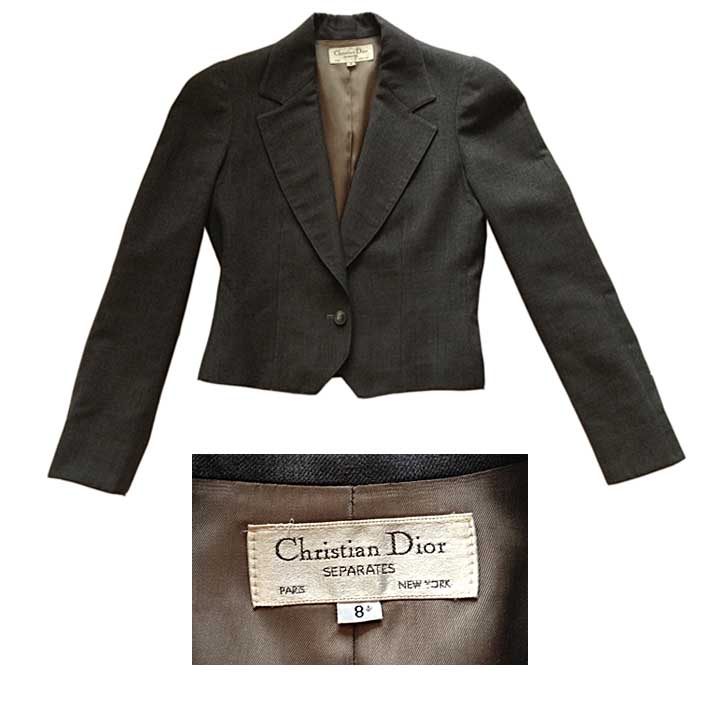
Christian Dior wool jacket, in perfect condition except for the loose front button. Thrift-shop price: $25.00!
Because I’ve been making clothes nearly all my life, sometimes I forget that certain skills are not, in fact, second nature to everyone. Even so-called basic sewing techniques involve specific instructions, as I discovered this week when I had to fix a dress whose hem had started to come undone. Just photographing the various steps in the process of hand-sewing approximately 11″ was eye-opening— there’s a lot to this seemingly simple repair!
Here’s the situation: It’s a sheath dress in a substantial stable knit, meaning it has some give, but also holds its shape; this quality has to be taken into consideration, as I’ll show you in a bit. Somehow, between the last time I wore it and, well, now, the hem started unraveling between a side seam and the center back seam. (This is a ready-to-wear dress, originally hemmed with the commonly-used clear monofilament that doesn’t tend to wear very well.)
The hem of my dress coming undone. For such a small section to be restitched, it’s actually quite a project.










 Changing Your Clothes